Tribo-electrostatic Separation (TES)
Charge-based dry fractionation for high-purity protein concentrates.
Research
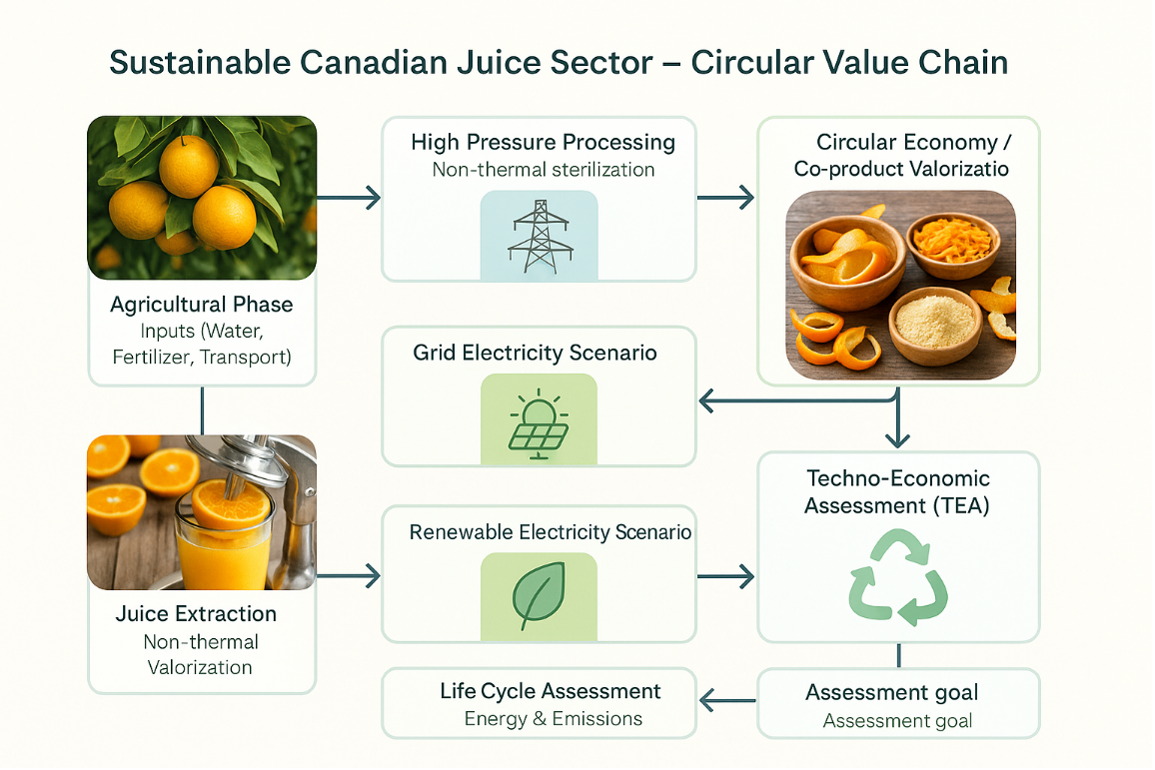
This research examines the High Pressure Processing (HPP) of orange juice in Canada through an integrated techno-economic (TEA) and life cycle (LCA) framework, covering the entire value chain from the agricultural phase to final juice packaging.
The study begins at the agricultural production stage, evaluating inputs such as fertilizer, water, and transport to juice processing facilities. The analysis then proceeds through extraction, HPP treatment, packaging, and distribution, providing a cradle-to-gate assessment of environmental and economic performance.
A key feature of the research is the comparison of energy sources for the HPP process:
Grid electricity, representing conventional Canadian energy mix, and Renewable electricity, such as hydro and solar integration. This dual-scenario approach identifies how clean energy adoption affects costs, carbon footprint, and overall sustainability of HPP juice production. Additionally, co-product valorization pathways—such as transforming orange peel residues into protein powders or bioactive compounds—are included to quantify circular economy benefits and economic gains from waste reduction.
Charge-based dry fractionation for high-purity protein concentrates.
Infrared-microwave processing to improve digestibility and functionality.
Lean, energy-aware processing to meet quality and sustainability targets.